Episode Transcript
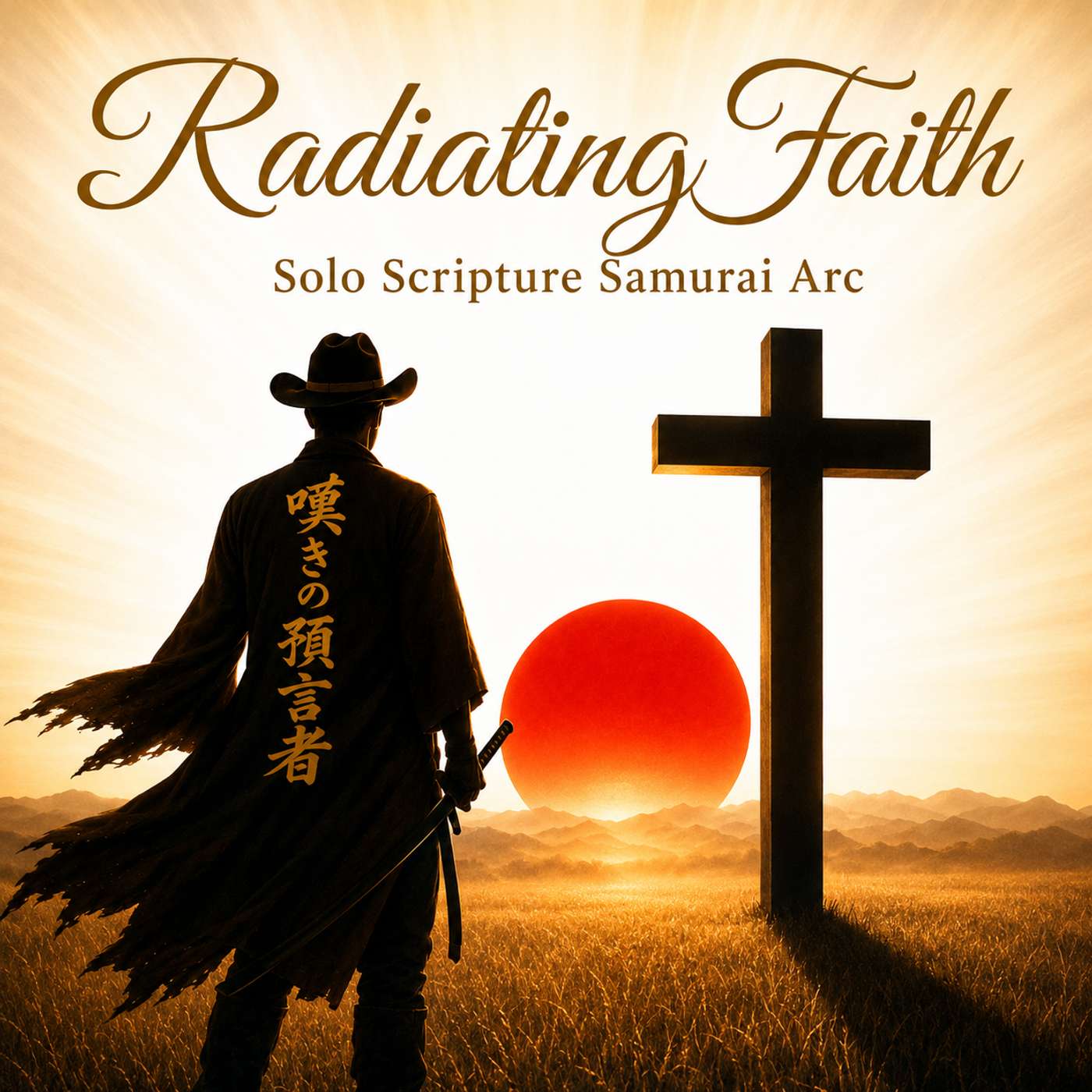
<p><!--block--> One of the most recognizable names in all of Japanese history is unmistakably that of Miyamoto Musashi. Whether you've seen him in recent anime or you've heard of The Book of Five Rings, most people have heard the name of Japan's legendary swordsman. That's why I'm excited to get into today's Japanese-inspired sermon, and this is part of the Solo Scripture Samurai arc of the Radiating Faith Ministry. And it's a topic I've spoken on many times before, and I continue to speak about, and that is biblical masculinity. Now, for those who aren't familiar with this series, uh, basically I lived in Japan for the summer. I've also been there a few times before that trip. And so I have been doing a lot of sermons inspired by my time in Japan. I wanted to do all of them while I was there. Time did not allow, and so this is part of that follow-up. Now, we've all heard of toxic masculinity, too far to one side, and then too far in the opposite direction, we've seen men who are just becoming radically feminized or turned into women. So there's this constant social war and shifting of cultures. It's very evident. We can see it all over. But the thing is, we're not to live according to the world, but according to the Word. And that contains the guidance we need for a balance between those two sides. I believe that between toxic masculinity and overly radical feminization of men, in the middle somewhere there's this balance that is biblical masculinity And part of the toxic masculine culture is that nowadays it's often the case where creating beauty or things of gentleness is considered demasculinizing of a man. That is a made-up word, I suppose, but you know what I mean, where we see men being called weak or feminine or gay or not a real man. Uh, in fact, some of the mindsets around masculinity, especially, especially on the further end of toxic masculinity, it's this question of who is a man to be a poet, a musician, or a painter, or dabble in those finer arts or more gentle things? We are to be warriors. We are to be protectors and providers. And all of those statements are true, yet to focus solely on those and to neglect the crafts and the other parts of a man that some may consider feminizing, that's not very true. In fact, we're gonna get into the scripture that refutes that. And we have here a real-life example, Miyamoto Musashi, who was not just a swordsman, but also an excellent artist. Mm, of course, the word excellent is up to opinion because art is subjective, but he's considered, uh, a great artist, more so for the fame of who he was and the artwork he created. But we'll get into his artwork today. You know, I didn't even know he was an artist. Most people don't know that I had only known who he was really from anime. And the thing is, after reading some of his work and doing some research in preparation for this sermon, I would say a lot of animes have represented him very inaccurately based on what we have accredited of his in writing. Of course, that's one of the things we'll get into is Musashi is a very romanticized and exaggerated historical figure, and so it's hard to tell what is real. And with that, fiction leaves much room to, you know, kind of represent him or shape him in whatever way. And they're not saying they're wrong for that. But I will say diving into the historical evidence we have of him is quite different from the actual him, although some of his writings are disputed as being, you know, finished or made by his students, not him. But of course, we'll get into all that. Now, I was at a bar in Hakone, Japan. I had wanted to go somewhere very local and get immersed in the culture, so it was a very quiet bar at one... For the majority of the night, it was actually just me and the bartender for the whole night. And we were talking about many different things, and I, I brought up, you know, one of my goals while in Japan was to investigate Miyamoto Musashi because of the new, uh, season of Baki, the fighting anime, where they actually incorporated the character of Musashi into it this summer. And so I was sharing with him about that. And the bartender surprised me by showing me artwork from Musashi and telling me that he was a, a, an artist, and I, I would have never guessed, right? You always hear about him as this, uh, people loosely word the, use the word stoic and other descriptions, uh, to describe him as a samurai, a warrior, a swordsman. You know, some people even say he's a blood-savage, blood-hungry beast, right? There's a lot of depictions of Miyamoto Musashi, not just in history and fiction, but just in people's own minds as they read some of his work or look at what he's done or some of the things that are accredited to him And so I was surprised to see the artwork. Uh, there was a gentleness to it, a beauty to it. And it was my intention to make it to some of the sites related to Musashi during my summer travels, but ultimately, unfortunately, I didn't get to go anywhere that I had hoped. And so that being said, I did get to research him now that I'm back in America. And if I go back to Japan, I definitely wanna check out some of those sites. And to be clear, because this is a sermon, you know, this is a faith-based biblical sermon, I want to make the distinction for anyone who's not aware that Musashi is a historical figure, but he's not a historical figure from or in the Bible. The reason I'm doing a sermon based around him is because as soon as I saw that he was both a painter and an excellent swordsman and warrior, I instantly thought of King David. For those who don't know, King David was not just a king, he was not just a mighty warrior, but also a shepherd, a player of the kinnor, which is an ancient form of harp and lyre. I actually own one. And we could venture to say a singer, at least a lyricist we know, and a dancer. Albeit perhaps he wasn't that good of a dancer based on some of the reactions. If you know, you know. Read the Bible. But yeah, we know that David was a man of many traits and crafts, some of which today would be called very feminine, especially the kinnor, uh, instrument, which again, a picture like the lyre or a small handheld harp, right? It's not what we think of nowadays when we think of masculinity. It's especially not what people on the farther end of toxic masculinity think of when they think of what it means to be a man Another caution I wanna give with all this, I mentioned that, you know, Musashi is not from the Bible. I also wanna mention that this isn't meant to glamorize or idolize him. This is not to project him as a Christian figure or as a role model. He and King David are gonna serve as conduits for the conversation which point us towards scripture, which is our role model. The scripture is our guidance. In fact, Musashi lived in undoubtedly, in undoubtedly in ways that were not Christian, you know. But we're gonna draw upon some parts of his life to address what are scriptural truths. So first, let's get a little bit into, uh, who he was, and more importantly, who he was beyond the blade and into the brush of the artwork. Now, again, a lot of the stuff about him is debated. We know that he lived approximately between 1584 and 1645. I've heard some commentaries say that maybe he was born in 1582, you know. But we know between 1584 and 1645. His birth and early life are the most widely debated, who's his real father, and what's his real name? There's a couple different names for Musashi that they say he went by, uh, some based on his hometown, some based on his father. We know him most commonly as Miyamoto Musashi. He's often associated with Hirama or Miyasaka. Now, this was during Japan's transition from the violent Sengoku period into the more stabilized Tokugawa Edo period. And the thing is, with these different periods, the samurai had kind of different mindsets. And so Musashi came from a very ti- a time where he saw a lot of combat theoretically. You know, it's debated what side he fought on and if he fought. But we know that he lived during a period of warfare compared to some of the samurai who wrote, uh, you know, pieces of literature after him, you know, came from a different time period that, that was more peaceful He was a famous wandering warrior. You know, he became a legend in Japanese culture, and a lot of the stuff that was, you know, made about him was after his time. He was known as a ronin, and later tradition accredited him victory in over 60 duels. Of course, they're not entirely clear or detailed. You know, we can't verify all of them. Much of his life is actually mythologized, but he is a real historical figure. One of his most famous battles, if not his most notable, was his duel against Sasaki Kojiro on Ganryujima, which has been replicated and speculated in many modern adaptations, such as manga and anime. I've seen a couple different shows where they have Sasaki Kojiro or Miyamoto Musashi. Now, Musashi's especially known for developing a two-sword style, which is later known as the Niten Ichi-ryu. Um, in fact, if I'm not mistaken, that was the name of his school as well, and it's often understood as two heavens as one or the two-sword strategy. Again, samurai typically had two swords, but they used both hands for one sword. Musashi, from what I've studied, said that basically it's a shame for a man to die, especially on the battlefield, having never used both swords. Why would you not use both swords? And, you know, he wrote extensively about why that style mattered and was, dare I say, superior. We know that he withdrew to Reigando Cave near Kumamoto, and there he composed The Book of Five Rings, and it was a strategic and philosophical work arranged around earth, water, fire, wind, and void. Um, some translations of void is ether. There's been multiple translations of The Book of Five Rings, and that last one, ether/void, you know, some say that his students actually finished that for him Now we've got a couple artworks here. Again, they're mainly accredited to him, although there's some historical debate around some of them, especially one of the ones we're gonna get into. Looking at the first one, it's the Koboku Meigetsu, which is Shrike on a Withered Tree. It's an ink painting of a shrike perched on a dead branch. It's extremely simple yet striking, and it visually communicates stillness, alertness, solitude, restraint, and controlled violence. I'm gonna have the artworks on display if you're watching the video form of this. Now, a shrike is a small bird, but it's a predatory bird, and so there's a quiet masculine tension there. You know, it's not a loud, muscular performative, but it is sharp, and I, I think that's interesting. You know, masculinity is not just an aesthetic, and even more so, it's more about performance and the internal than aesthetic. And so the shrike is an interesting bird to be chosen by Musashi. Now, again, we don't know why he chose it, and I could be projecting some symbolism onto it, but it's, dare I say, it's a uncanny coincidence. I think that, uh, it was very much chosen for a reason. But I will say all of these pretty much are birds, and so Musashi may have just liked birds. Because we look at the Uzu, the cormorant, and that is a bird. You know, it's dep-- it's a depiction of a bird, and this bird in Japan is tied to traditional fishing culture. But the scene, as the other ones, they have nothing to do with dueling or hardships or being a warrior, and it shows a connection to nature and the world that exists outside of that. And so I think it's important to note that a warrior's eyes, even that of Musashi, who was a famous warrior, who fought many times, uh, whether he was calm and stoic or whether he was a blood-savage warrior, we see that there's this connection to nature. Mm, so a disciplined man can also learn to see creation, rhythm, patience, and timing. In fact, a biblical man is especially called to do so You look at the Kobai Hatozu, the Red Plum and Pigeon. That's another painting of Musashi's, and what's super cool about it is that plum blossoms often carry associations of endurance. They bloom in the cold before spring fully arrives, right? So it shows resilience and endurance, and I think this painting between the plants and the bird, you know, looking at what kind of plants these are, it shows an engagement for Musashi with beauty, delicacy, and seasonal life, as well as a message if the plum blossoms were chosen just because of the association that they have. When it comes to art, we can only read so much into why the artist chose certain things, especially if they didn't write it down. Then you've got, I've got two translations for this one, the Roganzu or Ashikari, and it's called in English the Wild Geese and Reeds. Now, this particular piece is not fully confirmed to be his work. They attribute it to Musashi. It's certainly reminiscent of his work in many ways, in the style that is, but I also know just looking at it, to me, it looked a little bit different than what he normally does, although there were some remnants, but there are a lot of artists who grow or change as they continue in their craft. Either way, assuming it is from him, what we notice is that it's a tranquil scene of nature. Again, this is a six-panel artwork, and so it's actually the longest and biggest of the pieces, and again, it's a tranquil scene of nature. Aside from artwork, Musashi was known as a writer, but combining the writing and the artwork, you get calligraphy. And Musashi is attributed for the Fighting Spirit calligraphy piece. It's an adjacent creation, and it's not what we think about when we think about artwork per se, but it's a form of creative expression, and calligraphy is an especially beauting wr- beautiful writing style. You know, and that's just my opinion, but most people know that calligraphy is done to be, uh, you know, beautiful in style more than it is for functionality Now, as I mentioned earlier, he also created The Book of the Five Rings. I wanna clarify again, the writings from that are not equivalent to scriptural authority. They are not, I don't wanna say God inspired, because God could have inspired him some ways, but it's different than the, the breath and spirit of God that went into the creation of the Bible. And so we're gonna look at some quotes from it that are similar to the ideas cultivated from the word of God. But again, these are not scriptural in authority, but some of those ideas overlap, and, you know, I wanna make the tie-ins here. Later on, after we go through Musashi's work, we're gonna get into scripture itself that supports biblical masculinity. But before that, I wanna review a bit of Musashi's work. And again, I wanna be clear that we're not mistaking his writings for scriptural teaching, if you're tracking what I'm saying. I want to start with a saying from him, which was, "Bushi no michi wa bun to bu no futatsu no michi de aru." It is said the warrior's is the twofold way of pen and sword. Now, the surrounding section around that particular quote, it says that there are many arts and skills, including poetry, tea, archery, and other arts, and this is when Musashi says that the warrior should have a taste for both ways. I love this. First of all, you look at poetry and tea, the last thing masculine men on the, the further end of the more, uh, as we call it, the toxic side of masculinity would, uh, put forward normally. I love this, you know? I mean, these things were considered part of masculinity and a lot of things for a long time, and really, they got changed, uh, through- over time as our culture just shifted. But this quote, "Bushi no michi wa bun to bu no futatsu no michi de aru," you know, you look at that, and it directly rejects the idea that a warrior must be, as I said earlier, that a warrior must only be violent, physical, or emotionally hard. Musashi himself acknowledges a tradition where the warrior's path includes both pen and sword, among other gentle but dedicated interests. He understood what modern toxic masculinity has forgotten, that a warrior who only knows the sword is incomplete. Scripture goes even further. The Bible says that a man who only knows strength, but not worship, wisdom, humility, and love, is spiritually malformed, and we'll get into the scriptural evidence later, but keep that in mind Now, Musashi writes that after long study, he practiced many arts and abilities without a teacher. He understood that mastery is transferable, and discipline in one domain could expand into others. Swordsmanship, calligraphy, painting, writing, and strategy are not disconnected. They're all expressions of one disciplined life. Not only could they do this, but he knew that it was necessary to do so. Calling is not always one narrow thing. Sometimes God gives us skills to be used in a diverse range of ways, and I would dare to say that some Christians get so niched in their mind or their skills that they end up neglecting other callings God has for them, either with those same skills or using stuff learned from that particular interest. God doesn't always keep us in the same thing for life, and that's really important to know. When you look at 1 Peter 4:10, "Each of you should use whatever gift you have received to serve others as faithful stewards of God's grace in its various forms." God has given us gifts, these different skills and abilities and talents, and we should use them to serve others as faithful stewards of God's grace in its various forms And to say that in Japanese,それぞれの受けたたまものを持ちて互いに使いなさい。神の様々な恵みを柔術にかなりするものとして。 And then, you know, Musashi opens the ground book by saying,「兵法は武士の業である。」 Strategy is the craft of the warrior. He doesn't frame the warrior only as a brute. We already got into that, but here it goes again. He frames the warrior as someone with a craft, something studied, refined, measured, practiced. So real masculinity isn't an impulse, it's a craft. It's disciplined, it's cultivated, it's trained, it is submitted to a higher purpose. There is patience. And that is so important. He also says,「剣術の真の価値は剣術だけの中には見えない。」 The true value of sword fencing cannot be seen within the confines of sword fencing technique. In other words, the visible skill is not the whole man. A man is not only his physical ability, his job, his toughness, his aggression, or his public image. The true value of a man cannot be seen only in the visible technique. The deeper question is, what spirit governs the skill? The important biblical connection that I wanna make from all of this is that David's victory over Goliath wasn't just about a sling technique. You know, it was faith, covenant identity, courage, and trust in Yahweh that existed outside the confines of the slinging technique that played a role in that just as much, if not more. If we were to liken the sling to the sword, right? It's not just the sword fencing technique, it's what is outside of the confines of that Then lastly, the last quote we'll get into from Musashi He also said, Senri no michi o ippo zutsu ayume. Step by step, walk the thousand-mile road. This saying is truly reflective of discipline, patience, practice, commitment, and growth. Masculine balance is not instant. Now, I don't want people to listen to this sermon and, and think that listening to this sermon or any men's faith-based talks, because there's a lot of them out there, is going to be an instant change. I hope that you leave this feeling convicted. I hope that you surrender yourself to the Lord and He can work as fast or as slow as His will desires for you. And I hope that you work to change as soon as possible. But either way, a man doesn't become biblically masculine overnight. It's not just knowing these principles, it's living them. And, and to create them into a routine, a habit, and a disciplined part of your life, there's going to be struggle. There's going to be moments where you fall. It's about getting back up. We know that biblically, that's throughout it. You don't become a worshiper, a protector, a poet, a warrior, a husband, a father, a leader, or a servant in just one emotional burst. We know that it is formation. As we said earlier, it's a craft. A godly man is built step by step, not by pretending he has no emotions, not by taking a shortcut down the whole thousand-mile road, not by rejecting beauty or making things as feminine or seemingly feminine just because society said so, even though God didn't. We do this by submitting everything to God and step by step, not walking just the thousand-mile road, but the narrow path And with all of that said, I know that we spent a good amount of time here looking at just Miyamoto Musashi. Again, he's not a historical figure from the Bible, but he's a Japanese legend and considered one of the most ideal figures of masculinity in our society, not just in Japan, but globally. Yet this masculine man that people would describe as a powerful, stoic warrior was also an artist. He painted, he did calligraphy, he wrote. I told you earlier that reminded me of King David, who was both a psalmist and a warrior. So now I wanna move away from just the people who are, mind you, flawed people. Just as we are, you and I are flawed. You know, these people were flawed. So let's shift from examples of people who pursued that or tried to pursue that to actual commands and guidance from the scripture itself. Mind you, King David and the other men of the Bible were all flawed, as I said. But there was one man, a historical figure, who perfectly represented masculinity, and that is Yeshua, Jesus Christ himself. In all of that, he wept, got angry, loved. He was both a craftsman, a warrior of revelation, a teacher, a judge, a priest, a brother, a son, and so much more. You look at all of this, the most important part is his weeping and his anger, which God has also expressed continuously throughout creation. Society tells men not to cry and to be too angry. The Bible says there's a time for weeping and a time for anger. Control them wisely and express them justly. Now, I recognize that a sermon on this subject could go on forever, 'cause there's a ton of scripture on biblical masculinity. There are people who run multi-day conferences. There are multiple videos and whole things out there and long-form content, right? I'm not pretending that this sermon covers it all But I wanna focus on a few key points and some supporting scripture. We're gonna look at a couple quotes here. Now, the topic of weeping and crying, I've actually decided to make that a whole episode on its own. You know, Musashi didn't really talk too much about weeping and crying, maybe a little bit about grieving and stuff, um, so I don't wanna get it into it too much. But when we talk about Yeshua weeping, uh, grieving, other parts of the Bible where God is lamenting or Jeremiah is lamenting or David is lamenting, we're gonna get into that in a different episode. But for this sermon, I wanna focus on the, the balance, the idea of balance in biblical masculinity. I wanna start with using David again as a conduit for this conversation, looking at 1 Samuel 16:18 "I have seen a son of Jesse of Bethlehem who knows how to play the lyre. He is a brave man and a warrior. He speaks well and is a fine-looking man, and the Lord is with him." I love this. I mean, right off the bat, they describe him. He's a brave man, he's a warrior, but he speaks well. He's fine-looking, and most importantly, the Lord is with him, and he knows how to play the lyre. So we see a balance. We see all this. They, they don't just say, "Hey, David is this brutal warrior." No, he was, he was a fine-looking man. He was s- well-spoken, a brave man, and played the lyre. The Lord was with him, and we've seen historically what happens when we focus on aesthetics. "Oh, Saul is tall and manly and masculine aesthetically, so let's make him a king." And he was a, arguably a terrible king. But David, man after God's own heart, what do we know? What I'm telling you here, he's balanced, and God says, "I look at the content of character and not the outward appearance as people do." And that's a paraphrase, right? But the idea is scripturally supported. So I just wanna keep that in mind for everyone. Again, we went over First Peter chapter four, verse 10. Gifts are for service, right? It doesn't say use your gifts to become the ultimate man. It says to serve others. But caveat, serving others is part of being the ultimate man, and we're gonna get into that. I wanna take a look at Proverbs chapter 16, verse 32. I love this. "Better a patient person than a warrior, one with self-control than one who takes a city." Now, again, it doesn't say a warrior is useless, that conquest is useless. We know God had people be warriors and, and conqueror, right? But it says, "Better a patient person, one with self-control." This is a strong verse for emotional control, right? This is telling us that self-mastery is more valuable than external victory And, you know, I wanna get into Ecclesiastes, one of my favorite passages of scripture. You look at Ecclesiastes 3, we're gonna look at a few select verses here, verse one, four, and eight. "There is a time for everything and a season for every activity under the heavens: a time to weep and a time to laugh, a time to mourn and a time to dance, a time to love and a time to hate, a time for war and a time for peace." I mean, I love this because it's not saying to be emotionless. It's teaching us ordered emotion, wise timing, and righteous expression. What we see here is there is a time to weep. There is a time to laugh. There is a time to mourn. There is a time to dance. And there's a time to love, a time to hate, a time for war, and a time for peace. And some of you might shake your head and say, "Well, w- what if the wise teacher who wrote this was just saying, 'Hey, all these things are gonna happen in life.'" But it doesn't say there will be weeping, laughing, mourning, dancing, loving, hating, war, and peace. It says there's a time for everything I believe that the interpretation of this is that there's a proper time for these things. Mm, there's a time and place for these things, that you will have them in life and you w- will and should do them in life, but at the proper time, in the right season. And again, I know I'm gonna save it for another episode really, but I gotta look-- I can't overlook, you know, Yeshua wept, John 11:35 It's such a simple, yet truly devastating, and really we can't even avoid talking about it. The only man to ever exist perfectly wept. I mean, that alone tears down this idea that tears are inherently weakness. We know Yeshua wept on, on a couple different occasions, and one of them being grieving. Grieving over a man that he knew he could bring back to life and that he knew he was gonna bring back to life. So why cry? One, because he was human just as much as he was God, but also to show us, to be an example. I truly believe that he cried in the time of grief to show that death is a time for mourning, for weeping Now you look at Mark chapter three, verse five. The opposite of weeping, although some could say it's directly related, Yeshua's righteous anger. He looked around at them in anger and deeply distressed at their stubborn hearts, right? As we've said before, biblical masculinity is not the absence of emotion. It's emotion submitted to righteousness. And we know that Yeshua was righteous and perfect. Therefore, his anger was justified and true. But let me follow that up immediately with Ephesians chapter four, verses 26 through 27, which says, in your anger, do not sin. Do not let the sun go down while you are still angry and do not give the devil a foothold. Now, I love this because it doesn't say, do not be angry for that is a sin. It says, in your anger, do not sin. Anger is not a sin. It is unmanaged anger that becomes spiritually dangerous. In fact, look at James chapter one, verses 19 through 20. Everyone should be quick to listen, slow to speak, and slow to become angry because human anger does not produce the righteousness that God desires. So men shouldn't be passionate and angry, right? Men should be governed. Human anger easily outruns God's righteousness. That doesn't mean it's wrong to be passionate and angry, right? But you have to have it for the right reasons with the right heart, and it has to be disciplined Come on. We know that the fruit of the Spirit, according to Galatians chapter five, verses 22 through 23, the fruit of the Spirit is love, joy, peace, forbearance, kindness, goodness, faithfulness, gentleness, and self-control Toxic masculinity often hates gentleness, and passive masculinity can lack courage and self-control. But the spirit produces both gentleness and self-control And we know that strength without love is nothing. Look at 1 Corinthians 13:1-3. "If I speak in the tongues of men or of angels, but do not have love, I am only a resounding gong or a clanging cymbal." Fast-forward, "If I have a faith that can move mountains, but do not have love, I am nothing." Strength without love is spiritually malformed. Scripture does not let power, gifting, courage, faith, or sacrifice replace love. It is so important because as men, we can be doing all the right things out of routine or out of a masculine obligation and lacking the love behind it, and it's wrong And so I also wanna emphasize, sometimes we focus so much on the physical appearance, the aesthetics, and we know physical training has value, but it doesn't have the ultimate value. You look at 1 Timothy chapter 4 verse 8: "For physical training is of some value, but godliness has value for all things." Again, physical strength matters. I believe as a godly, righteous man, you should, uh, constantly pursue health and the improvement of your physical strength to serve others more abundantly. And discipline matters. Training matters. The mental and spiritual, uh, you know, effects that you can get from physical training is great, but that godliness needs to outrank the body's ability, and you can never make your body an idol And if you look masculine but can't behave or act masculine in a balanced way, then what's the point? And then what does God require? Of course, we, we w- we need to know that question. Looking at Micah 6:8, and I love to pull from here because, you know, uh, one of the lesser quoted parts of Scripture, uh, not this particular line, but Micah in general. This particular line is quite famous because it says, "He has shown you, O mortal, what is good. And what does the Lord require of you? To act justly and to love mercy and to walk humbly with your God." Justice, mercy, humility. None of those are marked as weakness. Uh, nothing is brutal. This is the balance in between overly weak and overly strong. There's a balance under God of justice, mercy, and humility. And I think humility is one of the most important parts I wanna just point out there real quick, because there's a lot of, uh, masculinity that is arrogant and narcissistic and cocky. Uh, there's a certain level of pride and self-worth and truth, but humility is important. And it's throughout the Bible. One of the biggest lessons of the Bible is humility And we need to acknowledge that God is our strength. Look at David's warrior strength in Psalm 144 lines one and two. "Praise be to the Lord my rock who trains my hands for war and my fingers for battle. He is my loving God and my fortress." David doesn't deny combat skill. He talks about training his hands for war and his fingers for battle. Not just him training them, but that the Lord is the one training them. That's the important part though. He's rooting it in the Lord. His warrior ability is not self-glorifying. It is part of serving others and serving God And we also need to know that no matter your warrior strength, that strength cannot save, right? In Psalm thirty-three, lines sixteen and eighteen and seventeen, it says, "No king is saved by the size of his army; no warrior escapes by his great strength. A horse is a vain hope for deliverance; despite all its great strength, it cannot save." What does this mean? I wanna use this quote to show that we're not getting into warrior admiration. Scripture respects strength, but it refuses to worship it, right? Because it is, uh, ultimately about God. And we know that if God says A, B, C, X, Y, Z to anyone or any nation of any strength, they cannot be saved except by Him alone. And so you can become what modern society dictates as the ideal man, but if it's a man that God wants to destroy because it is not a godly man, there is no point. Uh, there is no salvation in that strength. And then I talked earlier about what is part of being the ultimate man. It's service. If we look at Yeshua, Mark 10:43-45, "Whoever wants to become great among you must be your servant. For even the Son of Man did not come to be served, but to serve And this is from Yeshua, right? We talked about Musashi. We talked about David. A lot of you probably thought about Samson, right? Because we're talking about masculine men and strength. They're just a bunch of flawed men. And I don't say that to diminish them or disparage them, but Yeshua is the only one who had all the authority and he used it sacrificially as the perfect man. So ladies and gentlemen, like I said, we could spend all day going over the kinds of people that we should strive to be like, but really there's only one man that we need to pursue in being a biblically masculine person. That balance is in the example and model of Yeshua. But through historical figures like Miyamoto Musashi and King David and other people in the Bible, we see that successful, powerful men were balanced. And sure, there's plenty of overly toxic men who have been successful, but their success is not the success we're measuring, right? We're looking at spiritual salvation. We're looking at serving others. We're looking at godliness and righteousness. And so while Miyamoto Musashi was far from a perfect person and far from a righteous, godly person, what do we know? That he was a warrior and an artist, just as King David was, just as you and I are called to be. And so, again, this sermon is rooted in just the inspiration that as I was traveling across Japan, I learned that Musashi was both a warrior and an artist. And it made me think of David. It made me think of the Bible and all this modern commentary. There's a bunch of podcasts out there teaching men to be men again. There's sermons teaching biblical masculinity. There's, you know, online content teaching men to be women. There's all kinds of stuff being inundated toward us in this world. And I just want the real message of this sermon to be, go back to the Bible. If you are confused on what a man is supposed to be, don't go online to these different podcasts or social media clips. Don't go asking a survey of people on the streets. Open the Bible and let God show you what a true man is. </p><p><!--block--><br><br></p>